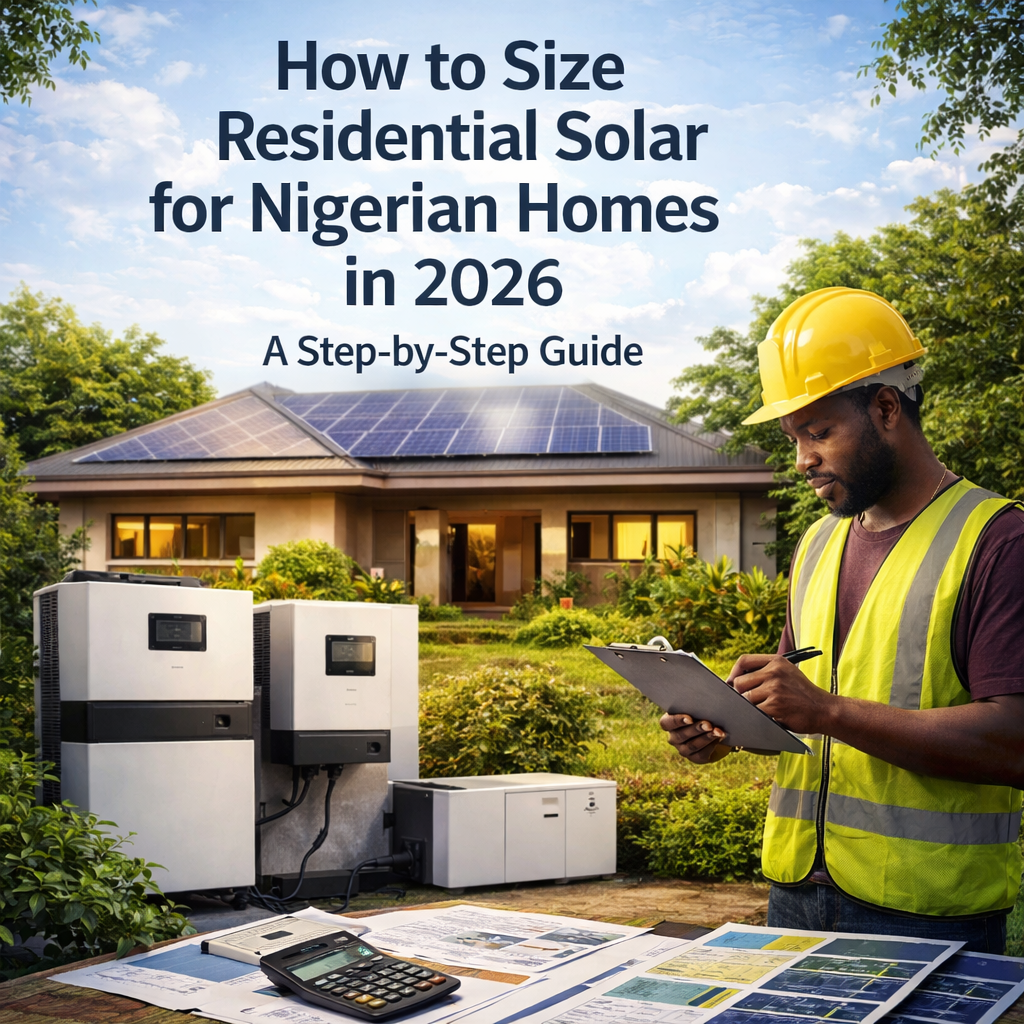
How To Size Residential Solar For Nigerian Homes In 2026
A Step-By-Step Guide That Actually Works
Nigeria added hundreds of megawatts of new solar capacity in 2025, and most of it came from off-grid and distributed systems. That tells you something important: more households are moving to solar — and many are getting the sizing wrong.
In 2026, correct sizing is the difference between:
- A system that feels powerful and reliable
- And one that constantly disappoints
This guide walks you through the exact process professionals use to size residential solar systems for Nigerian homes.
Key Takeaways
How do I start sizing solar for my home?
List every appliance you want to power, note the wattage and daily hours of use, then calculate your daily energy in kWh.
How many panels does a 3-bedroom house need?
Most essential-load homes need 1.5 kW to 3 kW of panels, depending on usage and sun conditions.
What inverter size works for most homes?
For typical families, 3.5 kVA to 5 kVA hybrid inverters are common because they allow future expansion.
How much battery storage is enough?
Many homes target 6–12 hours of backup for essential loads, usually between 5 kWh and 10 kWh of lithium storage.
Can I start small and expand later?
Yes. Modular systems are the smartest way to control upfront cost.
1. Understand How Solar Is Actually Used in Nigeria
Solar in Nigeria is not theoretical.
It replaces:
- Noisy generators
- Expensive fuel
- Unstable PHCN supply
Most residential systems are designed for essential load coverage first, not full 24-hour heavy appliance use.
Before you size anything, ask:
- What must stay on 24/7?
- What can remain on PHCN?
- What can remain on generator occasionally?
Once you separate essential from non-essential loads, sizing becomes engineering — not guesswork.
2. Step 1: List and Classify Your Loads
Start simple.
Write down every appliance and divide them into three groups:
Critical Loads
- LED lights
- Fans
- TV
- Router
- Refrigerator
- Security systems
Flexible / Heavy Loads
- Electric iron
- Pumping machine
- Microwave
- Water heater
- Air conditioners
Non-Essential Loads
- Decorative lighting
- Rarely used equipment
- Workshop tools
Now calculate daily energy:
Wattage × Hours per day = Wh/day
Then divide by 1000 to convert to kWh.
Example:
A 150 W fridge running 12 hours per day:
150 × 12 = 1,800 Wh
= 1.8 kWh per day
Example: 3-Bedroom Essential-Load Home
ApplianceQtyWattageHoursDaily EnergyLED bulbs1010 W6600 WhCeiling fans470 W82,240 WhTV1120 W6720 WhFridge1150 W121,800 WhRouter115 W12180 Wh
Total ≈ 5,540 Wh (5.5 kWh per day)
That number is your foundation.
3. Step 2: Factor in Nigerian Sun Hours
Nigeria has strong sunlight — but seasons matter.
In Lagos for example:
- Dry season: 5.5 – 6 peak sun hours
- Rainy season: 3.5 – 4 peak sun hours
For reliable design, always calculate using 4 peak sun hours unless you live in the far north.
Solar Array Formula
Required solar size (kW) ≈
Daily energy (kWh) ÷ Sun hours ÷ 0.75
(The 0.75 accounts for losses from heat, dust, wiring, and inefficiencies.)
Using the 5.5 kWh example:
5.5 ÷ 4 ÷ 0.75 ≈ 1.83 kW
Round up to 2 kW of panels for reliability.
If using 400 W panels:
2,000 ÷ 400 = 5 panels
That covers essential loads comfortably even in rainy months.
4. Step 3: Choose Panel Quantity Based on Roof Space
A standard 400 W panel takes about 2 m² of roof space.
So 5 panels need roughly 10–11 m² of usable roof.
When placing panels, check:
- Shade from water tanks
- Nearby buildings
- Trees
- Orientation and tilt
Poor placement can reduce output by 15–30%.
Panel count should always be based on energy need first — not roof size alone.
5. Step 4: Size the Inverter for Peak Load
Solar panels handle daily energy.
The inverter handles instant power demand.
To size it:
- Add appliances that may run at the same time.
- Apply a safety factor of 1.2–1.4.
- Convert watts to kVA using a power factor of 0.8.
Example:
Fans (280 W)
TV (120 W)
Fridge (150 W running)
Lights + router (150 W)
Total ≈ 700 W
With safety factor ≈ 1 kW.
But installing a 1 kW inverter leaves no room for growth.
That’s why most Nigerian homes install:
- 1.5–2 kVA for small apartments
- 3.5–5 kVA for 2–4 bedroom homes
- 7.5 kVA+ for homes running AC units
Always think 2–3 years ahead when choosing inverter size.
6. Step 5: Size Your Battery for Night Use
Battery storage turns solar into a true generator replacement.
To size batteries:
- Estimate night-time load
- Multiply by backup hours
- Divide by usable battery percentage
Example:
Night load = 500 W
Backup time = 8 hours
500 × 8 = 4,000 Wh (4 kWh)
Lithium batteries typically allow 80% usable capacity.
4 ÷ 0.8 = 5 kWh battery required.
That means a 5 kWh lithium unit is sufficient for overnight essential loads.
In 2026, many Nigerian homeowners start with 5–7 kWh and expand later rather than oversizing immediately.
7. Budgeting Realistically in 2026
Solar prices in Nigeria increased significantly between 2024 and 2025 due to FX pressure and import costs.
In 2026, general pricing tiers look like:
Entry-Level Backup
Small panels + 1.5–2 kVA inverter + compact battery
Mid hundreds of thousands of naira and upward.
Mid-Range Family System
1.5–3 kW panels + 3.5–5 kVA inverter + 5–10 kWh lithium
Typically in the low to mid millions of naira.
Larger or AC-Ready Systems
3–5 kW panels + larger inverter + 10–15+ kWh storage
Higher multi-million range depending on configuration.
Prices vary based on FX and component choice.
The smartest strategy is to:
- Cover essential loads first
- Add panels or storage later
8. Example System Sizes by Home Type
1-Bedroom Apartment (Essential Only)
0.8–1.2 kW panels
1.5–2 kVA inverter
3–5 kWh battery
3-Bedroom Family Home (Essential Loads)
1.8–3 kW panels
3.5–5 kVA hybrid inverter
5–10 kWh battery
Larger Home With 1–2 AC Units
3–5 kW panels or more
5–7.5 kVA inverter
10–15+ kWh battery
Actual design always depends on real load profile and budget.
9. Why Professional Design Matters
Undersized cables, poor breaker sizing, and weak mounting can shorten system life or create safety risks.
Proper engineering ensures:
- Correct surge handling
- Balanced charging
- Efficient panel layout
- Long battery lifespan
Solar is not just about buying panels.
It is about designing a complete power system that works quietly for years.
Conclusion
Sizing residential solar for Nigerian homes in 2026 is straightforward when you follow the right order:
- List and classify your loads
- Calculate daily kWh
- Size panels using realistic sun hours
- Choose inverter based on peak load
- Size battery for night usage
- Adjust design to match budget
When done correctly, solar becomes more than backup.
It becomes stable, quiet, predictable electricity that reduces generator stress and long-term fuel spending.